Soil
Bedrock of weathered granite, volcanic, and marine sedimentary rock, overlaid with sandstone, mudstone, and calcareous shales.
Built live from 3 tasting rooms: a routed itinerary and a field guide to the ground you’ll cover.
What you poured here. Saves as you go.
What you poured here. Saves as you go.
What you poured here. Saves as you go.
A short field guide to the ground you’ll cover, the districts, their soils, and the people who shaped them. It’s what turns 3 tastings into a day you understand.
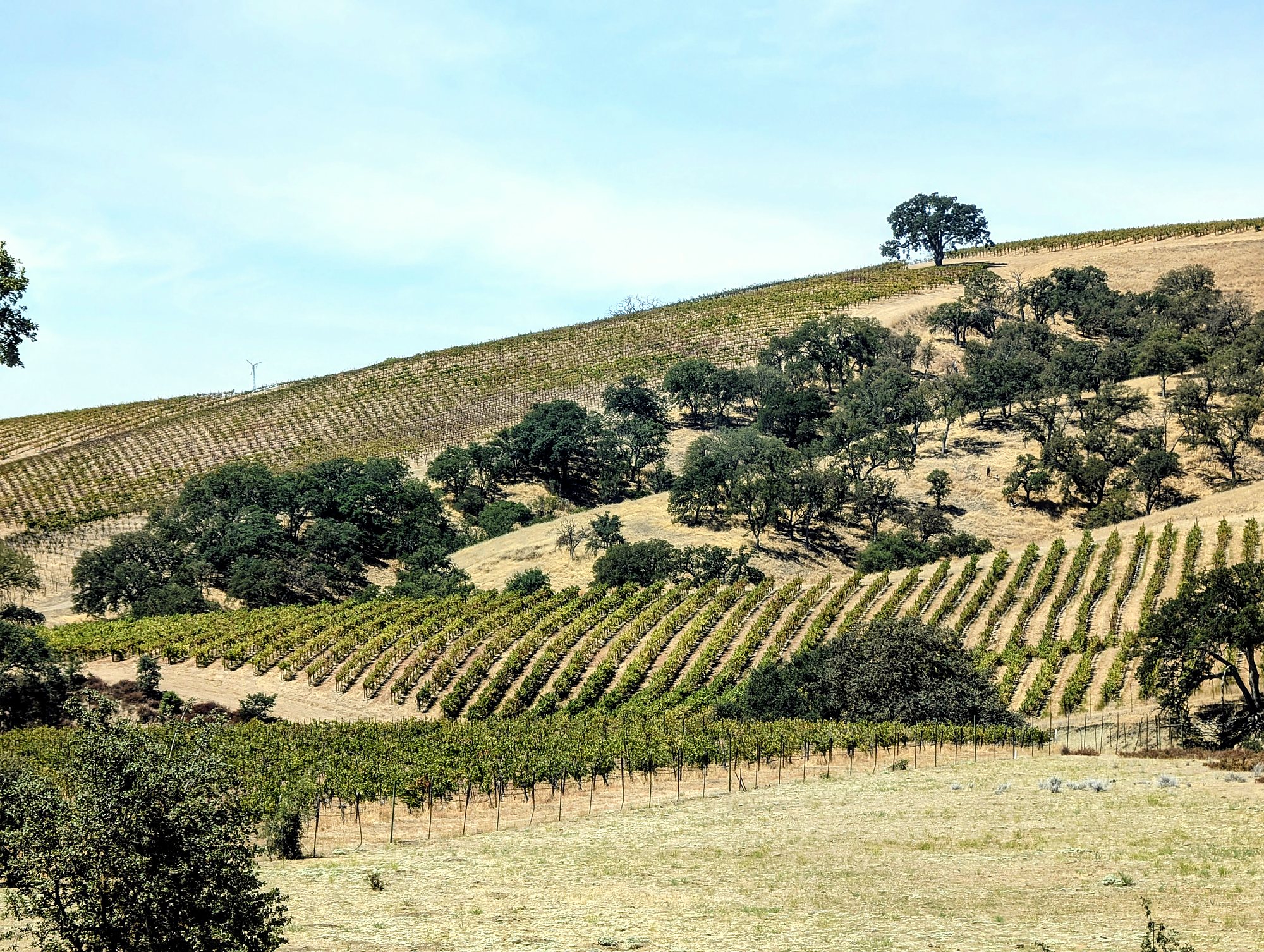
Paso Robles spans more than 614,000 acres on the inland side of the Santa Lucia Range — three times the size of Napa Valley, and for over 30 years the largest undivided AVA in California until it was split into 11 sub-districts in 2014. Its signature is diversity: over 45 distinct soil series, elevations from 700 to 2,400 feet, and rainfall ranging from a desert-like 10 inches a year to nearly 40 inches at altitude.
The number that explains Paso is the diurnal swing — often close to fifty degrees between a hot afternoon and a cold night. Coastal air pulls through the gaps in the Santa Lucia range after dark and drops the temperature hard. Fruit ripens fully in the heat and then holds onto its acidity overnight, which is why wines from a place this warm rarely taste flabby.
Limestone-rich hills on the west side, old river terraces to the east.
Ocean air slips in through the Templeton Gap on the west side.
Known for a big swing from hot afternoon to cold night.
Long, hot, sunny summers.
Afternoon breeze on the west side, calmer to the east.
Valley floor to steep hills well above it.
High and cool west-side district (up to 2,400 ft) on limestone and calcareous soils; benchmark for age-worthy Rhône reds and Cabernet.
Lime-rich shale and mudstone over limestone bands. Drains fast and keeps vines working.
The most coastal corner of Paso: morning fog and cool breezes reach it.
Nights drop hard, so acidity holds after hot days.
Warm afternoons ripen Rhône and Bordeaux grapes fully.
Sheltered hillsides, light afternoon breeze.
The highest vineyards in Paso, some above 2,000 feet.
These stops sit inside Paso Robles but outside its named districts, either because they pour fruit sourced from several areas or because their tasting room sits in town rather than among the vines. Ask what vineyard the wine in your glass came from, the answer is usually more specific than the label.
“Rhône” refers to grape varieties from France’s Rhône Valley, not a place in California. Reds lean on Syrah, Grenache, and Mourvèdre, often blended as a “GSM”, for peppery spice, dark fruit, and earthy depth. Whites include Viognier, Roussanne, and Marsanne, richer and more perfumed than Sauvignon Blanc. Paso Robles and parts of Santa Barbara have become California’s Rhône strongholds, planting the same grapes in similarly warm, dry conditions.
Climate shapes flavor more than almost anything else in the glass. Cool-climate grapes, grown near fog, wind, or the coast, like Sta. Rita Hills Pinot Noir, ripen slowly, keeping bright acidity and lighter, more delicate fruit. Warm-climate grapes, grown inland, like Paso Robles Zinfandel, ripen fast and fully, producing riper fruit, higher alcohol, and softer acidity. Neither style is “better”, it’s why the same grape can taste completely different depending on where along the Central Coast it grows.
These certifications aren’t interchangeable. “Sustainable” (e.g. SIP Certified, Napa Green) covers a broad scorecard, water use, habitat, labor, but still allows some synthetic inputs. “Organic” (USDA/CCOF certified) prohibits synthetic pesticides and fertilizers in the vineyard. “Biodynamic” (Demeter certified) goes further, treating the vineyard as a self-sustaining ecosystem and following a lunar/astrological calendar for farming tasks. All three signal lower intervention; biodynamic is the strictest and least common.
In the U.S., “Reserve” has no legal definition: it’s a marketing term a winery applies to a bottling it considers a step up, often meaning more selective fruit or more new oak, but the standard varies producer to producer. “Estate” (or “Estate Grown/Bottled”) is more meaningful: by federal rule, the grapes must be grown, and the wine made and bottled, entirely at wineries the producer owns or controls within one AVA, a real guarantee of vineyard-to-bottle control.
A note for the whole day. Open any stop above to add tasting notes and photos for that winery.
Written from your own notes. Nothing is invented, so the more you write down, the better it reads. You can edit it after.