Regions / Paso Robles
Paso Robles
California's largest and most geologically diverse red-wine appellation.
Explore all 248 Paso Robles tasting rooms on the map →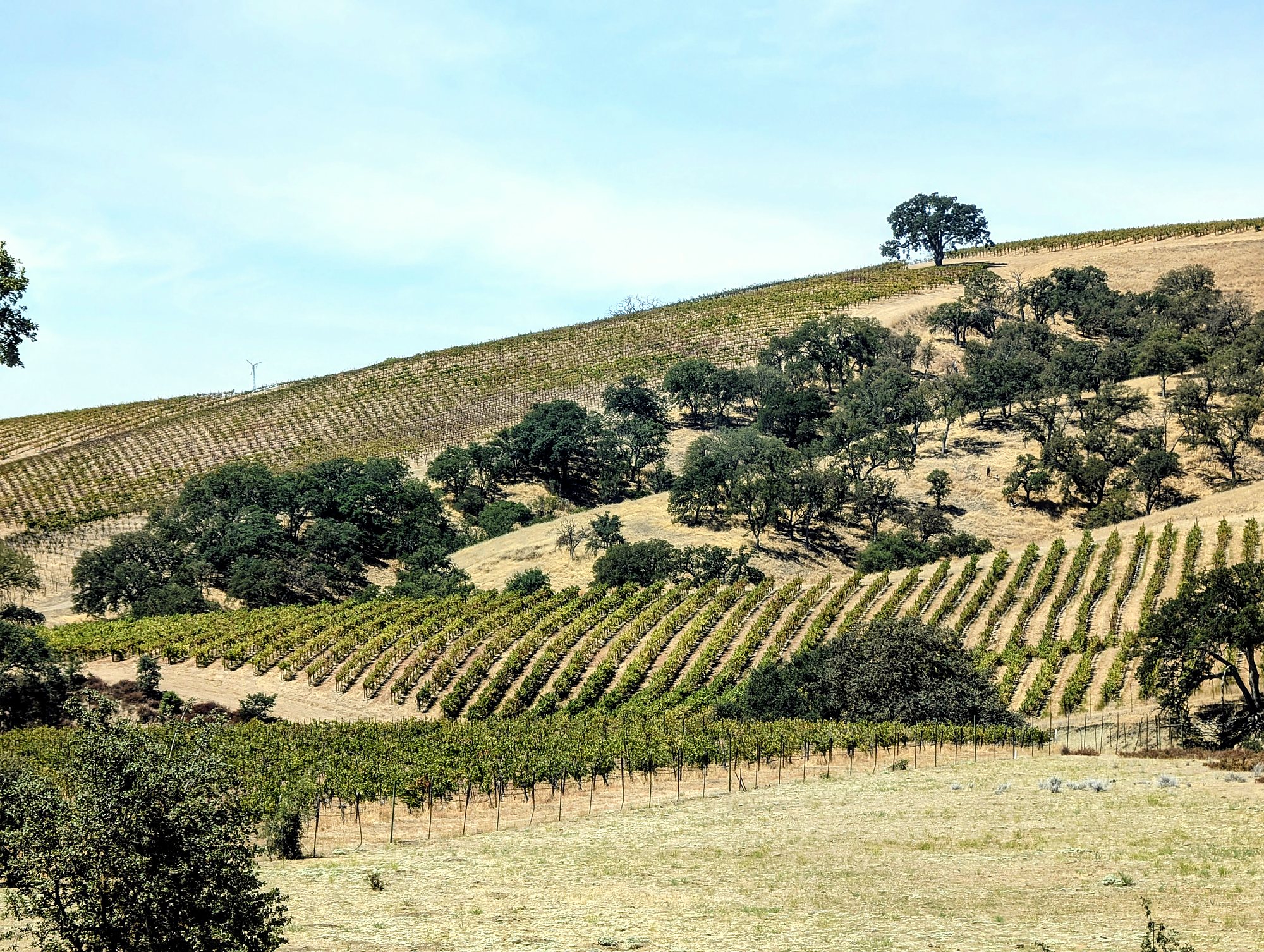
California's largest and most geologically diverse red-wine appellation.
Explore all 248 Paso Robles tasting rooms on the map →Paso Robles spans more than 614,000 acres on the inland side of the Santa Lucia Range — three times the size of Napa Valley, and for over 30 years the largest undivided AVA in California until it was split into 11 sub-districts in 2014. Its signature is diversity: over 45 distinct soil series, elevations from 700 to 2,400 feet, and rainfall ranging from a desert-like 10 inches a year to nearly 40 inches at altitude.
Warm and continental despite its proximity to the Pacific, because the coastal hills shield most vineyards from marine influence — producing hot days and dramatically cool nights. The Templeton Gap, a series of narrow river valleys through the Santa Lucia Range, lets cool coastal air 'breathe' into the region in the afternoon and evening, moderating the west side.
Bedrock of weathered granite, volcanic, and marine sedimentary rock, overlaid with sandstone, mudstone, and calcareous shales. Paso is home to the largest calcareous (high-lime, clay-based) soil formation in California — soils that raise pH, reduce vine vigor, and concentrate flavor while preserving acidity in a warm climate.
Winegrowing dates to the 18th-century mission era, but the modern era began in the 1970s, when a small group of growers planted Rhône varieties at a time when California was planting Cabernet almost everywhere else. The Paso Robles AVA followed in 1983, on a petition carrying 51 local grower and winery signatures. The region is now the epicenter of California's Rhône movement, alongside bold Cabernet and heritage Zinfandel.
Each sub-appellation has its own soils, elevation, and climate. Tap through to the map filtered to that area.
Chalky, white calcareous soils and high lime content; home to the oldest Zinfandel vines in Paso (Ueberroth, planted 1934) and prized for structured Rhône blends.
View Willow Creek District on the map →High and cool west-side district (up to 2,400 ft) on limestone and calcareous soils; benchmark for age-worthy Rhône reds and Cabernet.
View Adelaida District on the map →The coolest, windiest district — the gap that funnels Pacific air inland. Cooler-climate Syrah, Grenache, and Pinot flirtations.
View Templeton Gap District on the map →Large, warm northeastern district on alluvial terraces; broad plantings of Cabernet and Rhône reds.
View Estrella District on the map →Central district with moderate marine cooling through the Templeton Gap; balanced reds and increasingly whites.
View El Pomar District on the map →Warm, low-elevation northern district along the Salinas River; the likely site of the region’s first mission-era vines. Zinfandel, Petite Sirah, Grenache.
View San Miguel District on the map →Warm eastern district on old terrace and hillside soils mixing granitic and sedimentary rock; Cabernet, Merlot, Petite Sirah, Syrah, Zinfandel.
View Creston District on the map →Warm valley-floor district on silty clay loams; a workhorse for ripe Cabernet, Syrah, and Zinfandel.
View Geneseo District on the map →Southernmost, highest-rainfall district; a mountain-valley climate on alluvial slopes producing Syrah, Cabernet, and Zinfandel.
View Santa Margarita Ranch on the map →Paso Robles’s most continental and remote district, sitting highest and furthest east along the AVA’s rim, where thin, rocky soils and minimal marine influence produce some of the region’s largest day-to-night temperature swings. That extreme diurnal shift slows ripening even in the heat, concentrating color, tannin, and flavor in Cabernet Sauvignon, Zinfandel, and other structured reds.
View Highlands District on the map →Other recognized AVAs in Paso Robles without a tasting room in our directory yet: San Juan Creek.